Designer
Erika Lopez

EEG Headphones
Mixed Individual and Group Project
2021
Alívio
The headphones that directly relieve your anxiety

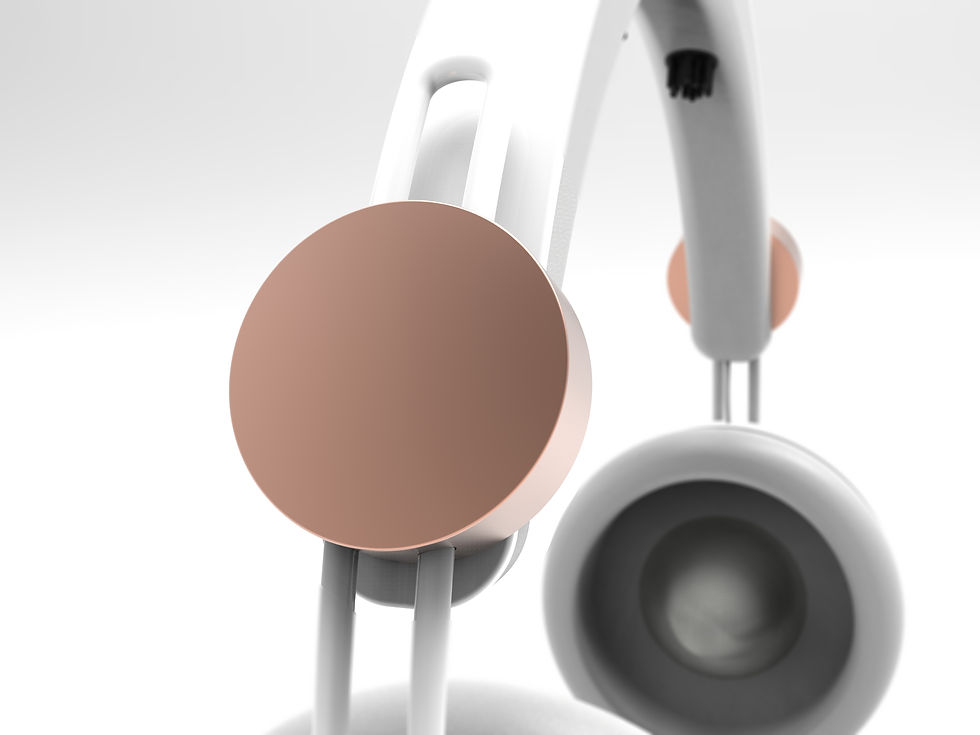
This project’s task was to design headphones that could be paired with an app that can interpret brain waves to benefit the user in some way. I chose to use music as a way to relieve the user’s anxiety.
Anxiety and music activate some of the same parts of the brain. The “fear network” are the main areas of the brain affected by anxiety, which includes the amygdala, insula, and cingulate cortex system. Music affects the hippocampus, amygdala, insula, and cingulate cortex system.
Music can influence emotions, which can help people process their emotions, and promote dopamine release during individually preferred music. Music therapy can help relieve stress and symptoms of neurological disorders, including depression and anxiety.


From the research, I gathered that by utilizing music selection machine learning and sensors detecting the parts of the brain that are involved in emotions related to anxiety, I can design integrated headphones that recognize when someone is experiencing anxiety and recommend certain music to alleviate the symptoms.
The EEG locations are crucial in gathering accurate data. This product gathers data from the anterior insula and parietal lobe, with a potential to reach the amygdala and gyrus areas, which are deeper in the brain. To gather that data, dry hair EEG sensors are placed on the C3 and C4 locations, and soft, dry sensors are placed under conductive fabric inside the ear.

Two rounds of ideation were conducted before a final design was chosen. Eventually, one concept was chosen to develop into the full product. A 3D CAD model of the headphones was created and then 3D printed full scale for prototyping.



References
Ayata, D., Yaslan, Y., & Kamasak, M. E. (2018). Using Wearable Physiological Sensors. IEEE Transactions on Consumer Electronics, 64(2), 196–203.
Chen, G., Hu, Z., Guan, N., & Wang, X. (2021). Finding therapeutic music for anxiety using scoring model. International Journal of Intelligent Systems, 36(8), 4298–4320.
Erkkilä, J., Punkanen, M., Fachner, J., Ala-Ruona, E., Pöntiö, I., Tervaniemi, M., Vanhala, M., & Gold, C. (2011). Individual music therapy for depression: Randomised
controlled trial. British Journal of Psychiatry, 199(2), 132–139. https://doi.org/10.1192/bjp.bp.110.085431
Erkkilä, J., Punkanen, M., Fachner, J., Ala-Ruona, E., Pöntiö, I., Tervaniemi, M., Vanhala, M., & Gold, C. (2011). Individual music therapy for depression: Randomised
controlled trial. British Journal of Psychiatry, 199(2), 132–139. https://doi.org/10.1192/bjp.bp.110.085431
Koelsch, S. (2014). Brain correlates of music-evoked emotions. Nature Reviews Neuroscience, 15(3), 170–180. https://doi.org/10.1038/nrn3666
Nierman, M., & Nierman, M. (2018). The Science Journal of the Lander Music and the Brain Music and the Brain. 12(1).
Salimpoor, V. N., Benovoy, M., Larcher, K., Dagher, A., & Zatorre, R. J. (2011). Anatomically distinct dopamine release during anticipation and experience of peak emotion
to music. Nature Neuroscience, 14(2), 257–264. https://doi.org/10.1038/nn.2726
Shackman, A. J., & Fox, A. S. (2021). Two decades of anxiety neuroimaging research: New insights and a look to the future. American Journal of Psychiatry, 178(2), 106–
What is Amygdala Hijack? (with pictures). (2023, September 11). The Health Board. https://www.thehealthboard.com/what-is-amygdala-hijack.htm

